
Alfons Anker (1872-1958)
Alfons Anker was born into a Jewish family in Berlin on the 1 December 1872. He studied at the Technische Hochschule in Berlin, where his teachers included Professors Strack, Koch and Jakobsthal. He interrupted his studies to learn the masonry trade before returning to complete his qualifications in architecture. After graduating he worked for several years as an assistant to various architects such as Ludwig Otto and the firm Reimer and Korte, and for public organisations such as the Magistrat der Stadt Berlin and the Hochbau-Amt. He then began practicing independently.
He fought in the First World War and earned accolades for his construction of field shelters. Following the war, Anker became First Assistant to the Geheimen Regieerungerat Prof. Sesselberg at the Technische Hochschule in Berlin, and Technical Manager of the Reichsverband zur Forderung Sparsamer Bauwise. With Sesselberg he worked on building ‘Test-Settlements for Returning Warriors’, accommodation for war veterans designed as they wished, built free of charge and making use of natural materials.
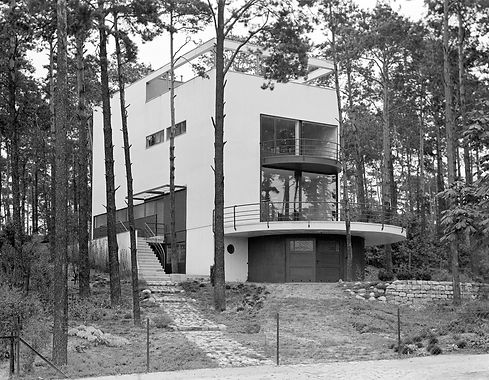
House, Am Rupenhorn 24, Berlin (1928)
RIBA Collections
In 1924, he went into partnership with Hans and Wassili Luckhardt. They worked on designs for housing in Berlin-Dahlem and Leipzig-Gohlis as well as taking on commercial projects, including the redesign of Potsdamer Platz and Alexanderplatz in Berlin. In 1933, the Luckhardt brothers ended their partnership with Anker on account of his Jewish origins and he began to work on a freelance basis. However, he struggled to find long-term or significant projects. In this period he also attempted to emigrate to the United Kingdom and was recommended to the Home Office for a labour permit by the RIBA Refugee Committee.
In 1939, as his situation became more desperate, he emigrated to Stockholm where his daughter’s family were based and was granted Swedish citizenship. He began work at the S.A.R. Hakon Ahlbrg practice and in 1940 he founded Utlandspublikationen. In the years that followed, he wrote numerous articles about aspects of Swedish and German architecture for a range of publications and also took up photography.
After the war, Anker returned to Berlin. He was involved with the foundation of the Forschungsinstituts fuer Internationales Krankenhauswesen, now the Institute for Health Sciences at the Technische Hochschule in Berlin. He became an Honorary Senator of the TU Berlin in 1958. Anker died in Stockholm on the 14 December 1958.
Bibliographical References
Zur neuen Wohnform: Architekten Luckhardt and Anker (Bauwelt Verlag, 1930)
‘Four terraced houses at Schorlemer Allee 12-12c, Berlin-Dahlem’, Architekt, no. 1, 1977 Jan., p. 8
Bruder Luckhardt und Alfons Anker: Berliner Architekten der Moderne (Akademie der Kunste, 1990)
Klemens Klemmer, Judische Baumeister in Deutschland : Architektur vor der Shoah (Deutsche Verlags-Anstalt, 1998)
RIBA Collections References
Telschow-Haus, Potsdamer Platz, Berlin
Ac5
Remodelling of an old building, Berlin
Ac76/1-2
House, Heerstrasse 161, Berlin
CJN452
House, Am Rupenhorn 24, Berlin
CJN453- CJN454
Terraced houses on Schorlemer Allee, Dahlem, Berlin
FH/H&F/1/A


RIBA Refugee Committee Papers